
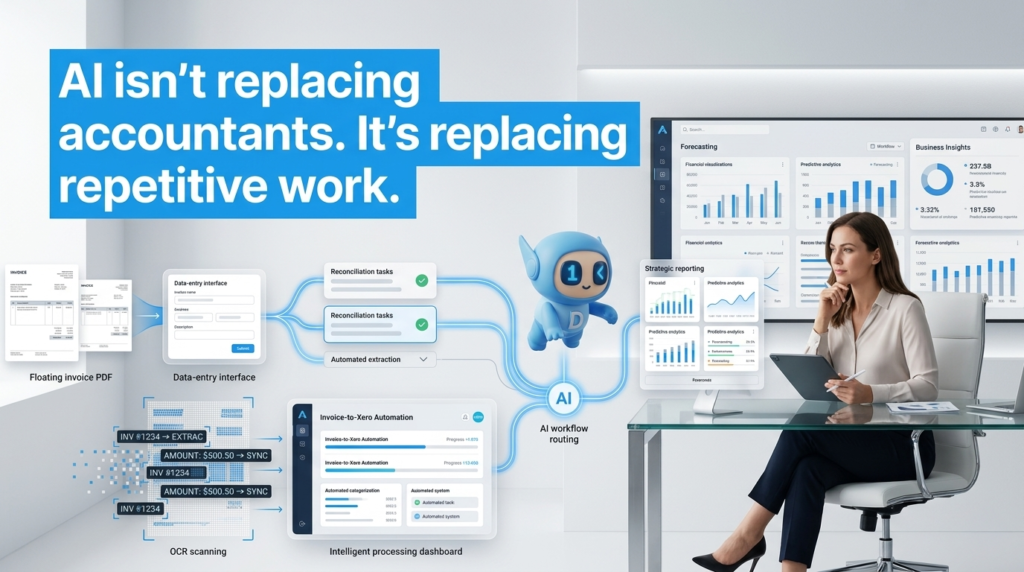
AI is not coming
for accountants.
It is coming for their most tedious work.
There is a difference.
What the data actually says about AI and accounting jobs and why the leaders who act on this first will be the ones who come out ahead.
The conversation about AI and jobs has been going around in circles for a while now. On one side: the alarm millions of roles will disappear, automation is coming for white-collar workers, the accounting profession as we know it is finished. On the other: the reassurance AI is a tool, not a replacement, it will free you up to do more meaningful work, you have nothing to worry about.
Both versions are partial truths that, taken alone, mislead more than they inform. The reality is more nuanced, more specific, and if you are prepared to look at it honestly more actionable than either camp suggests.
This piece is an attempt at that honest look. We’ll use actual data, cite where it comes from, and end with a practical point about what accounting leaders should be doing right now. Let’s start with what the research says.
The global picture: displacement and creation happening simultaneously
The largest ongoing study of AI’s impact on employment comes from the World Economic Forum. Their 2025 Future of Jobs Report, which surveyed more than 1,000 employers representing 14 million workers across 55 economies, paints a picture of simultaneous disruption and creation.
jobs projected to be displaced by AI by 2030
WEF Future of Jobs Report 2025
new jobs projected to be created in the same period
WEF Future of Jobs Report 2025
of businesses say AI and information processing will affect their operations by 2030
WEF Future of Jobs Report 2025
The net figures a projected gain of 78 million jobs globally are less useful than the composition of those numbers. The jobs being displaced are, with remarkable consistency across every study and sector, the ones characterised by being routine, rule-based, and data-intensive. The jobs being created are, equally consistently, the ones that require judgement, relationship, creativity, and strategic thinking. The profession is not disappearing. It is sorting itself into two categories: work that machines can do better, and work that humans will always do better. And one of those categories is shrinking.
What the accounting industry itself is saying
Karbon’s 2024 State of AI in Accounting Report surveyed 595 accounting professionals globally and found a profession that is clear-eyed about the change coming even if not yet fully prepared for it.
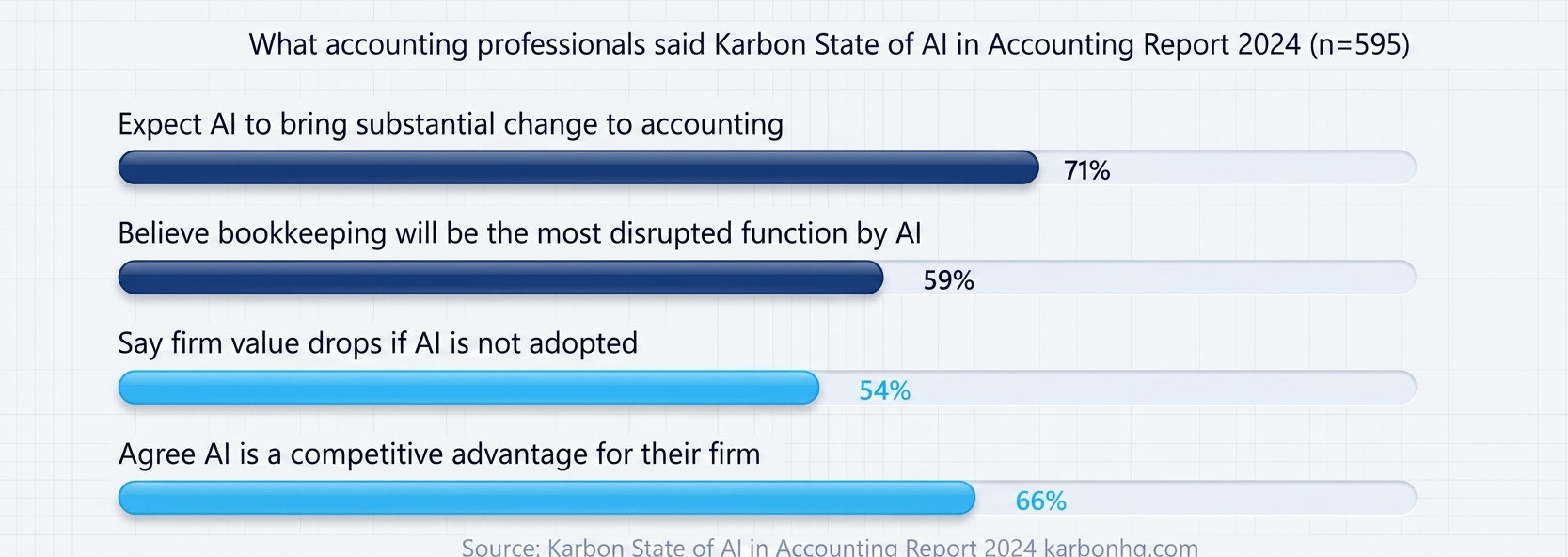
Accounting professionals are clear that AI will reshape the profession and that those who don’t adopt it
will fall behind.
That last figure is worth sitting with. Two in three accounting professionals believe that AI adoption is already a competitive advantage not a future consideration, but a present-day differentiator between firms pulling ahead and those standing still. And yet, despite that belief, the same study found that only 25% of firms are actively investing in AI training for their teams. The gap between what people believe and what they are doing is exactly where risk accumulates.
For the sharpest illustration of how fast the shift is occurring: Wolters Kluwer’s 2025 Future Ready Accountant report found that AI adoption in accounting firms jumped from just 9% to 41% in a single year. Whatever window exists to adopt early rather than adopt late is closing faster than most people in the profession realise.
So which accounting tasks are actually going?
Here is where the conversation stops being abstract. The research is not saying that accountants are going. It is saying, very specifically, that certain types of accounting work are going and it identifies them clearly. They share a set of defining characteristics.
Tasks with highest automation risk in accounting confirmed by multiple studies
Routine data entry manually keying information from received documents into accounting systems High Risk
Invoice processing receiving, reading, extracting, and recording supplier invoice information High Risk
Transaction categorisation sorting income and expense records against predefined categories
Account reconciliation matching records across systems to confirm they align
Standard financial reporting generating routine period-end reports from existing data
The Stanford Graduate School of Business study published in 2025 was one of the most rigorous analyses of this to date. Researchers found that accountants who adopted AI to handle routine tasks finalised monthly statements 7.5 days faster and spent 8.5% less time on routine processing with no reduction in quality. In fact, nearly two-thirds of participants said that automating routine tasks was the single biggest benefit of AI adoption.
The study’s conclusion is careful but clear: AI is not replacing accountants. It is replacing the parts of accounting that most accountants would tell you, honestly, they didn’t get into the profession to do.
Now let’s look at invoice processing specifically
Every single characteristic that research identifies as making a task ripe for automation applies, completely, to manual invoice processing. It is rule-based. It is repetitive. It produces a well-defined output from a well-defined input. It requires no judgement, no client relationship, no ethical reasoning, no strategic insight. And the data on what it costs in time, money, and accuracy is substantial.
Australia-specific data Australian Taxation Office & Deloitte Access Economics
Paper invoice (manual processing)
PDF invoice received by email (manual processing)
e-Invoice (automated processing)
Source: Australian Taxation Office study conducted in collaboration with Deloitte Access Economics. Reported by DocuClipper, citing ATO cost benchmarks docuclipper.com
That Australian data is striking. The invoice that arrives in your inbox as a PDF the type most Australian businesses receive from their suppliers every single day costs on average AU$27.67 to process manually. The moment that same invoice is handled through automation, the cost drops to AU$9.18. For a business receiving 200 invoices a month, that is a difference of over AU$44,000 a year.
The global picture reinforces this. According to Ardent Partners’ 2024 State of ePayables Report, the average time for a business without automation to process a single invoice is 17.4 days from receipt to resolution. The Institute of Finance and Management puts the average manual cost per invoice at $16 USD, compared to as little as $3 USD with best-in-class automation an 80% reduction.
average days to process one invoice without automation
Ardent Partners State of ePayables 2024
error rate per invoice in manual processing each error costs up to $53 to fix
Industry data via resolvepay.com
of small and medium businesses still enter invoice data manually
DocuClipper Accounts Payable Statistics 2025
And for those who want to put it in pure time terms: the average accounts payable clerk takes 12 minutes to manually process a single invoice, according to Skynova’s invoicing statistics. A business handling 300 invoices a month is spending 60 hours one and a half full working weeks on an activity that AI can perform in seconds, more accurately, without a single manual step.
“Almost two-thirds of accounting professionals said that automating routine tasks was the single biggest benefit of adopting AI not because it was the most impressive feature, but because it gave them their time back.”
Stanford Graduate School of Business, 2025 Study on AI in Accounting
The honest answer to “will AI take my job?”
Let’s address this directly, because it is the question underneath all of this. The answer depends almost entirely on which parts of your job we are talking about. Research on this is consistent across every source we found:
The work that is being automated and the work that isn’t
Data entry and routine document processing high automation confidence now. This is where AI is performing reliably and where the ROI is clearest.
Transaction matching and reconciliation increasingly handled by AI in larger operations, moving into SME range as tools improve.
Cash flow forecasting and financial analysis AI assists with synthesis and modelling, but the interpretation and advisory conversation remains human.
Client advisory, strategy, ethics, and judgement calls specifically identified by Stanford, the CPA Journal, and the WEF as the work that remains irreducibly human. These are the roles that are growing in value.
As the CPA Journal put it in its 2025 analysis: “As tedious tasks are increasingly able to be performed by AI, accounting work that consists of repetitive tasks can be phased out.” The profession is not disappearing. It is clarifying separating the work that deserves a skilled human’s attention from the work that, if we’re honest, never deserved it in the first place.
There is one more data point worth including here, because it speaks to the competitive urgency of this. A 2024 study cited by Coursiv found that AI-skilled finance workers command an average 56% wage premium over those without AI competency up from 25% the previous year. The market is already pricing the difference between professionals who have adapted and those who haven’t.
What this means if you lead an accounting team
The data presents a clear picture. The routine, data-entry components of accounting operations are transitioning to AI not as a future scenario but as a current commercial reality, happening at different rates across different organisations. The teams that have already automated invoice processing and routine data work are not just saving money; they are freeing up skilled professionals to do work that adds more value, builds client relationships, and commands higher fees.
The question for anyone running an accounting operation in Australia today is not whether to engage with AI automation. The data on that is settled. The question is where to start and where to start is with the task that fits the automation profile most completely, that touches your operation most frequently, and that your team would give up most willingly.
Invoice processing ticks every box. It is rule-based. It is repetitive. It carries a well-documented cost premium AU$27.67 per PDF invoice in Australia, according to the ATO’s own research. It carries a data-entry error rate of around 1.6% that compounds into reconciliation issues downstream. And it is, by every measure, the task that accounting professionals are most ready to hand to a machine.
The Case, In Plain Terms
Invoice data entry is boring. It is time-consuming. It is repetitive. It must be done but it adds no analytical value. It carries a real financial cost and a real error risk. AI is designed precisely for work that fits this description. The transition is not coming it is underway, and the firms benefiting from it are the ones that started first.
Where AirDoc AI fits into this
Most tools in the invoice automation space reduce the manual effort involved in processing invoices. They give you a scanner, a portal, or an app. They make the data entry faster. The step still involves you you are still the person who opens the email, retrieves the attachment, and initiates the process.
AirDoc AI does something different. It connects directly to your email inbox where invoices already arrive, every day, without any action from you and handles the entire process without your involvement at all. The invoice arrives, AirDoc AI reads it, extracts the data, and posts it to your accounting platform accurately and automatically. There is no step that requires your attention.
That complete removal of human involvement from the process is, practically, what the transition to AI is supposed to feel like. Not faster data entry. No data entry. The work that was costing your organisation time, money, and accuracy eliminated at the point where it enters your business.
For accounting leaders looking to understand what AI adoption actually looks like in practice, rather than in theory, this is the clearest possible place to start. The setup is quick, the outcome is immediate, and the time your team recovers from day one is time they can invest in the work that no AI will touch: the advice, the relationships, the analysis, the judgement. The work the profession was always meant to be about.
Sources cited in this article
Start the transition today.
Connect your inbox to your Xero account and let AirDoc AI handle every invoice that arrives. The first task to automate is always the clearest one.
Get in touch or start your trial
Set up in under 15 minutes. No invoice data entry on your first day. Guaranteed.