
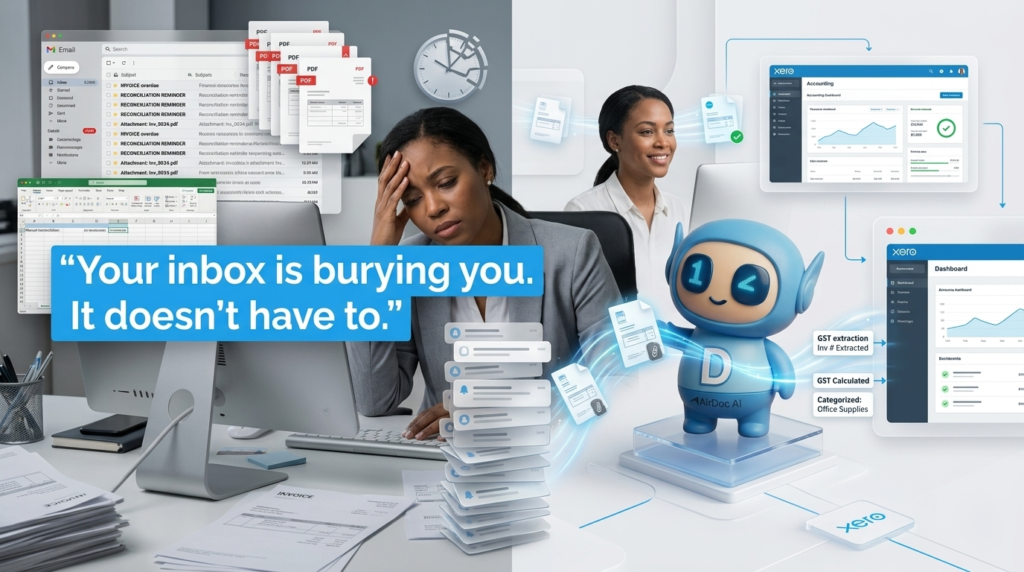
Your inbox is burying you.
It doesn’t have to.
How Australian businesses are finally breaking free from the invoice data-entry trap and why the ones doing it are already a step ahead.
Let’s be honest about something. Somewhere in your week maybe it’s a Tuesday afternoon, maybe it’s that quiet Friday morning before anyone else gets in, there’s a window of time that quietly disappears. You open the inbox. You scan for invoices. You open an attachment, then another. You start squinting at line items, checking GST, typing figures into Xero. An hour passes. Sometimes two.
It’s not glamorous work. It’s not the kind of work you got into accounting or business management to do. And yet, it has to be done. Until now, that’s just been the deal.
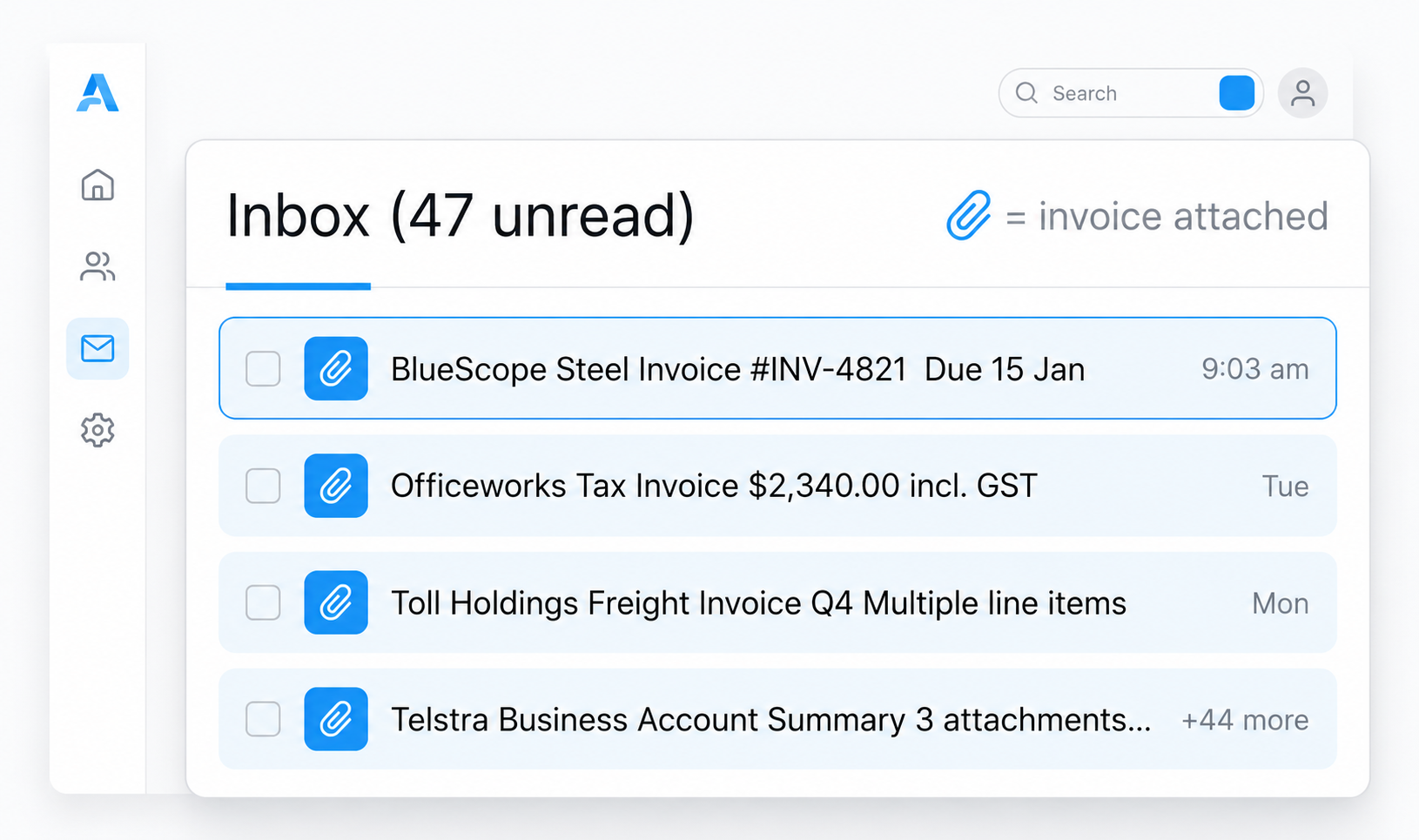
Sound familiar? For many Australian finance teams, this is just another Monday morning.
The hidden tax on your time
There’s a concept in business called “invisible work”, the tasks that don’t appear in any strategy document but quietly consume your most valuable resource: time. Invoice processing is one of the most persistent examples of this. You receive an email with a PDF attached. You open it. You verify the supplier. You check the amounts. You enter each line into your accounting software. You reconcile. You move on to the next one.
Now multiply that by the number of suppliers your business works with. Multiply it by twelve months. Multiply it by the hourly rate of the person doing it. The number you land on is, frankly, uncomfortable.
minutes per invoice
when done manually
average cost to process
one invoice manually*
of that time is spent
just finding the email
*Average cost per PDF invoice processed manually, per Deloitte Access Economics (via ATO)
And this isn’t just about money. It’s about the kind of work you’re doing with your best thinking hours. Invoice data entry doesn’t need your experience, your judgement, or your expertise. It needs patience and a good Wi-Fi connection. That imbalance is worth thinking about.
“The goal was never to become faster at data entry. The goal was to not be doing data entry at all.”
The tools that promised to help and almost did
In fairness, the accounting tech space has been trying to solve this for a while. Document scanners, OCR tools, receipt capture apps there’s been no shortage of products promising to take the pain out of invoice processing. And many of them are genuinely useful, to a point.
But here’s what most of them ask of you: a step. A login. An upload. You still need to go and get the invoice, open another application, drag a file across, wait for it to process, then check whether it read the numbers correctly. The friction is lower. But it’s still there. You’re still in the loop, touching each document, being the bridge between your email and your accounting software.
That gap between your inbox and your books turns out to be exactly where the problem lives.
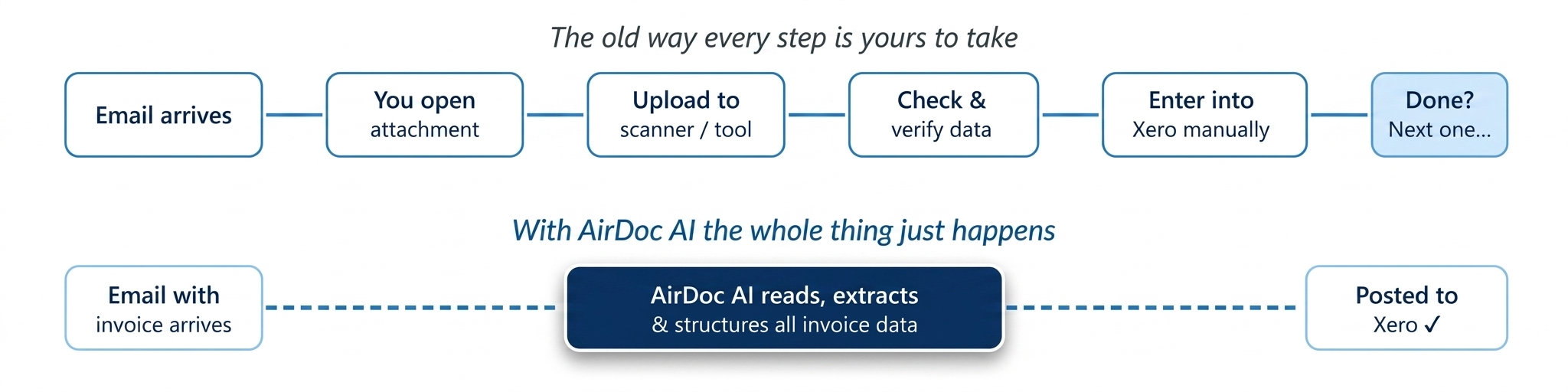
Top: the traditional approach, where you are every step. Bottom: the AirDoc AI way your inbox
connects directly to your books.
What makes this different and why it matters
AirDoc AI does something that, until now, no other tool in this space has actually done cleanly: it connects directly to your email inbox. Not a scanning portal. Not a mobile app you photograph invoices with. Your email. The place invoices already land, every single day, without you doing anything.
The moment an invoice arrives in your inbox, AirDoc AI sees it. It reads the attachment regardless of whether that’s a PDF, a scanned document, or an emailed invoice and identifies the relevant data, and posts it accurately to Xero. Supplier name, invoice number, line items, GST, due date. All of it. Without you opening a single attachment. (If we encounter any problems with any invoice, we always flag them as well so that you can intervene only in such scenarios but AirDoc AI always learns from how you fix such cases as well)
This might sound like a small distinction. It isn’t. Every other tool in this space still requires a handoff from you. You are still the bridge. AirDoc AI removes that bridge entirely, which means you’re not just working faster you’re genuinely not working on this at all.
The hands-off difference
Most automation tools reduce the steps you take. AirDoc AI eliminates your involvement altogether. By connecting directly to your inbox, it catches every invoice the moment it arrives no uploads, no logins, no checking. Your books stay current without you lifting a finger.
A walk through what actually happens
For those who like to know exactly what they’re handing over here’s the full picture of how AirDoc AI works in practice.
Inbox connection
AirDoc AI connects securely to your email account. It watches for incoming emails with invoice attachments PDFs, scanned docs, or inline invoices.
Intelligent identification
Not every email with an attachment is an invoice. AirDoc AI identifies genuine invoices automatically, ignoring everything else.
Data extraction
Supplier details, ABN, invoice number, individual line items, GST amounts, totals, and due dates extracted accurately, every time.
Xero posting
The extracted data is posted directly and accurately to your Xero account coded, categorised, and ready for your review or approval.
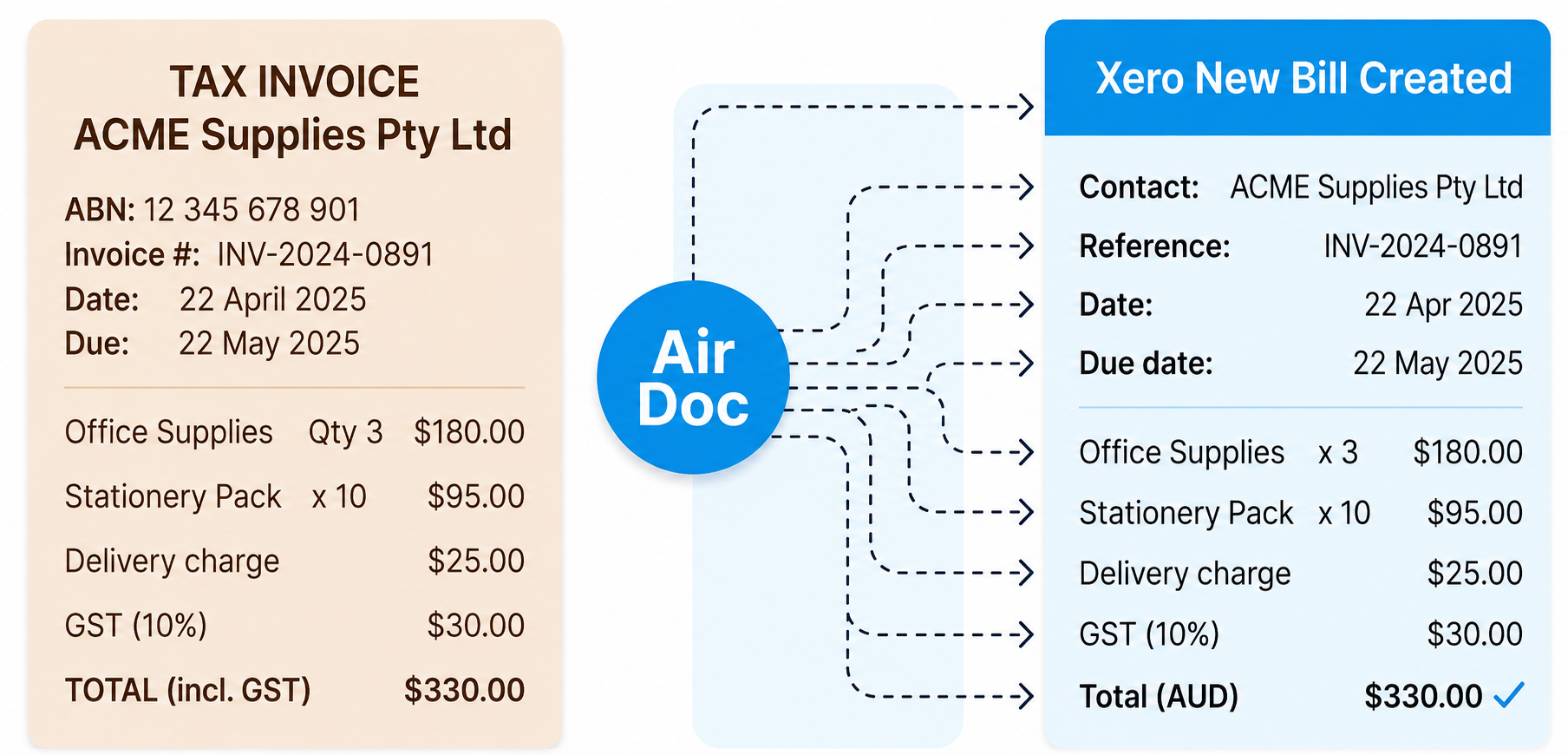
AirDoc AI reads every field from the invoice and maps it precisely into Xero line items, GST, due dates,
the lot.
This is the era of letting go
There’s a quiet transformation underway in how Australian businesses operate, and it doesn’t always make the headlines the way it deserves to. The businesses that are pulling ahead right now aren’t necessarily the biggest or the best-funded. They’re the ones that have figured out which parts of their operation deserve human attention and which parts don’t.
Invoice processing is a perfect example of the latter. It is rule-based, repetitive, and well-defined. It has a known input (an invoice), a known output (an entry in your accounting software), and a well-trodden path between the two. There is no nuance that requires your judgement. There is no client relationship that depends on your instinct. It is, in the most literal sense, a task designed to be automated.
What AI has done genuinely, practically is make that automation accessible. Not to large enterprises with expensive ERP systems and dedicated IT teams. To the bookkeeper running accounts for three SME clients. To the founder of a 15-person manufacturing business in Brisbane who does their own accounts on Saturday mornings. To the finance manager at a growing wholesale company in Melbourne who is drowning in supplier invoices every Monday.
Before AirDoc AI
- ⌛ Hours per week spent on invoice entry
- ⚠️ Occasional data entry errors affecting reconciliation
- 📥 Invoices sitting unprocessed in inbox
- 😤 Best hours spent on lowest-value work
- 🔄 Same task, every week, forever
With AirDoc AI
- ✅ Invoices processed the moment they arrive
- ✅ Accurate extraction every field, every time
- ✅ Xero always up to date, without you touching it
- ✅ Your time reclaimed for work that actually needs you
- ✅ Complete inbox-to-books automation, end to end
What do you do with the time you get back?
This is the question that doesn’t get asked enough when people talk about automation. The conversation usually stops at efficiency you’ll save X hours, you’ll reduce Y errors. All true. But the more important question is: what becomes possible when the grind is gone?
For an accountant or bookkeeper, reclaimed time typically flows into the work that actually builds a practice. Advisory conversations with clients. Proactive cash flow analysis. Spotting unusual patterns in spending. The kind of work that strengthens relationships, drives better decisions, and genuinely can’t be done by a machine. The work that, if you’re honest with yourself, you got into this field to do.
For a business owner doing their own books, it’s simpler: it means getting Saturday mornings back. It means not being behind. It means one less thing that follows you home from the office.
“The businesses pulling ahead aren’t the ones working harder. They’re the ones that have decided certain work belongs to software and they’ve acted on that decision.”
Handing off invoice processing to AirDoc AI isn’t just a productivity upgrade. It’s a signal to yourself, to your team, to your clients that your business is operating in the present. That you’ve made the conscious decision to use AI where it belongs, so that human capability can go where it’s irreplaceable.
Companies in every sector are making this transition right now. The ones that do it thoughtfully choosing the right tools, implementing them carefully, and redirecting the freed-up capacity toward higher-value work are the ones building the kind of operations that will still be competitive in five years. Not because they automated for automation’s sake, but because they understood what the technology was actually good for.
Small step, real shift
Connecting AirDoc AI to your inbox and your Xero account takes minutes. The change it creates is immediate and permanent. From that point on, every invoice that arrives in your inbox gets processed, extracted, and posted without you being involved at all.
That’s not just convenience. In a market where time, accuracy, and focus are the real competitive currency, it’s an edge worth having.
See AirDoc AI in action
Connect your inbox. Watch your invoices process themselves.
Your books will be more current than they’ve ever been.