Your Inbox Is Costing You
More Than You Think
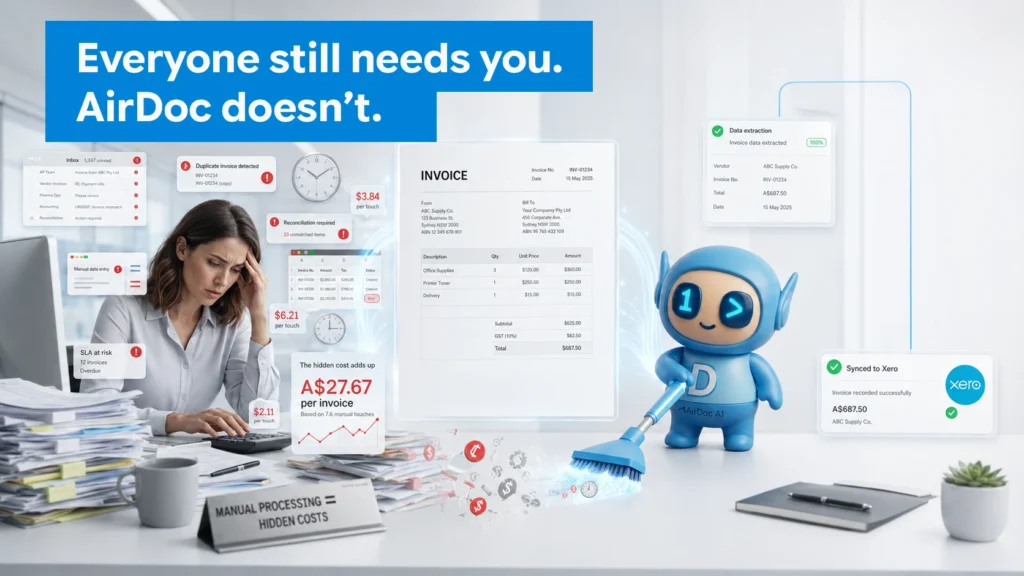
Every invoice your team manually touches is A$27.67 in hidden cost. Here’s why leading Australian organisations have stopped paying that tax – and what they switched to.
There’s a ritual that plays out in accounting firms and finance teams across Australia every single day. An email arrives with a PDF attachment. Someone opens it, squints at the supplier name and amount, opens the accounting software, and starts typing. Then the next one arrives. And the next.
We’ve dressed this up with names like “invoice processing” and “accounts payable management.” But let’s call it what the research says it is: an invisible tax on your team’s time and your firm’s bottom line.
The document-capture software market has spent the last decade promising to fix this. Dext (formerly Receipt Bank), Hubdoc, AutoEntry, and their peers all offer some version of the same pitch: snap a photo or forward an email, and the data appears in Xero. For many firms, these tools have been genuinely transformative. But in 2026, a new class of competitor is exposing some uncomfortable truths about the incumbents – and Australian accounting firms and finance teams are taking notice.
This is a detailed look at how the leading tools compare, where each one falls short, and why a new entrant – AirDoc AI – is winning clients from some of the country’s most demanding finance operations.
The Real Cost of “Good Enough”
Before comparing software, it’s worth anchoring on the scale of the problem. Industry research paints a confronting picture for any firm still relying on manual or semi-manual invoice handling:
For an accounting practice processing 500 invoices a month across its client base, the manual cost alone exceeds A$13,800 per month in staff time. The tools reviewed below all reduce that figure – but not equally, and not without their own friction and costs.
What the Market Looks Like in 2026
Reviewing thousands of user ratings across G2, Capterra, Trustpilot, the Xero App Store, and practitioner communities on Reddit and LinkedIn, a clear picture emerges: the praise across every product is remarkably similar (saves time, easy capture, syncs with Xero) – but the complaints are where products diverge, and where decisions should be made.
Hubdoc – stalled development, lost its flagship feature
Xero removed bank-statement “fetch” in 2022 and formally marked line-item extraction “not in pipeline” in mid-2025. Its Xero App Store rating sits around 3.3-3.5 stars – far below competitors in the very store that matters most to accountants.
Dext – best-in-class accuracy, but brutal pricing trajectory
Annual renewals rising 10-30% since the 2021 IRIS acquisition. The per-client model with a 10-client minimum penalises firms with many small clients. Support is slow (24-48h responses, no phone line) and billing disputes are a recurring complaint.
AutoEntry – sync failures and expiring credits
Items marked “published” that vanish before reaching Xero or Sage. Credits expire after 90 days. Perceived as stagnant since the Sage acquisition. Mixed Trustpilot picture: great support agents alongside persistent glitches.
Expensify – powerful for employees, problematic on contracts
A D- BBB rating driven by auto-renewal complaints and near-impossible cancellation. A 2024-25 UI overhaul was widely criticised. Built for employee expense submission, not accountant-side document capture – a category mismatch many buyers miss.
The pattern is consistent: incumbents built their reputation solving the capture problem. But in 2026, the battleground has shifted. Firms don’t just need their invoices scanned – they need the entire workflow from inbox to Xero to require zero human touches. That’s a fundamentally different product requirement, and it’s where the market is moving.
Enter AirDoc AI: The Inbox-First Approach
Most document-capture tools require a human bridge: someone must forward the email, snap the photo, or upload the file. The tool then processes it. The human is still part of the loop – just handling a different step.
“Clicking through emails to verify invoices isn’t ‘accounting’. It’s busywork. It’s a massive, invisible drain on your team’s focus and your firm’s bottom line.”
– AirDoc AI
AirDoc AI attacks the problem at a different point. Rather than waiting for someone to submit a document, it connects directly to your Microsoft 365 inbox, monitors for incoming invoices automatically, extracts the data – supplier details, line items, GST – and posts directly to Xero. The human bridge is removed entirely.
This matters for Australian firms and finance teams for a specific reason: the dominant failure mode isn’t bad OCR or poor integrations. It’s friction at the front end. Suppliers email invoices. Those invoices sit in inboxes. Someone has to remember to process them. AirDoc eliminates that step.
Secure inbox connection
Connects to Microsoft 365 and automatically identifies all emails containing invoices – no forwarding rules needed.
Intelligent extraction
Trained on thousands of formats. Reads PDFs, images, and text – extracting supplier details, line items, and GST with precision.
Direct Xero posting
Extracted data is structured and posted to Xero immediately. Your books stay current without Friday afternoon backlogs.
Complete audit trail
Every invoice is logged with full traceability – what was processed, when, and how. Total visibility for compliance.
Head-to-Head: How AirDoc Compares
Based on cross-platform review analysis and published product specifications as of June 2026:
| CRITERIA | AIRDOC AI | DEXT | HUBDOC | AUTOENTRY |
|---|---|---|---|---|
| Workflow trigger | Automatic (inbox monitoring) | Manual submission / email-in | Manual submission | Manual / email-in |
| Line-item extraction | Yes, included | Yes (may be add-on) | No – not in roadmap | Yes, included |
| GST / tax handling | Automatic, ATO-aligned | Yes | Basic | Yes |
| Xero integration | Direct, real-time | Mature, real-time | Native (Xero-owned) | Yes (some sync issues reported) |
| Audit trail | Complete, per-invoice log | Yes | Basic | Yes |
| Pricing model | Subscription, by email volume | Per-client, 10-client min | Free / bundled with Xero | Credit packs (expire 90 days) |
| Price trajectory | Transparent, locked | +10-30%/yr since 2021 | Stable (free tier) | Stable, credit changes noted |
| Setup overhead | Near-zero (inbox connect) | Supplier rules per client | Moderate | Moderate |
| Human step required | None for standard invoices | Submit / forward email | Upload / mobile capture | Upload / email-in |
| Bank-statement fetch | Not primary use case | Yes (select banks) | Retired 2022 | Yes |
| Free trial / entry tier | 500 free emails/month, no card | Trial, then paid | Free with Xero subscription | Trial available |
| Support model | Direct support | Email only, 24-48h | Xero support | Live chat (praised, but reactive) |
The table reveals something important: AirDoc doesn’t win on any single feature in isolation. It wins on the combination of automation depth (no human trigger required), pricing transparency (pay per invoice, no minimums, no expiry), and workflow fit (most supplier invoices arrive by email; AirDoc is built precisely for that reality).
Real Results From Australian Organisations
AirDoc AI isn’t a startup promise – it’s already deployed in some of Australia’s most demanding finance environments:
Australia’s largest multi-family office automated invoice processing from a single inbox, saving 30+ hours per month. CFO Jason Smith credits AirDoc with freeing his team for higher-value client advisory work.
A 150+ year South Australian agricultural enterprise uses AirDoc to automate administration and reduce operational costs – proving the solution scales across industries, not just accounting practices.
A fast-growing Australian premium beverage company uses AirDoc to eliminate invoice admin, freeing leadership bandwidth to focus on commercial growth rather than back-office processing.
These aren’t early-adopter experiments. These are established, operationally sophisticated Australian organisations that evaluated the full market and chose AirDoc for its combination of automation depth, reliability, and ROI clarity.
The Pricing Case Is Unusually Clear
One of the most common frustrations in the document-capture category – surfaced repeatedly in review data – is pricing complexity and unpredictability. Dext’s per-client model penalises growth. AutoEntry’s credits expire. Expensify auto-upgrades without notice.
AirDoc takes a different approach: pay for what you scan, start for free
500 emails per month.
2,000 emails per month. Under A$0.08 per email.
5000 emails per month. Under A$0.06 per email.
10,000 emails per month. Under A$0.05 per email. Talk to Support for higher volume.
For a business scanning 2,000 invoice emails a month, the Growth plan works out to well under A$0.10 per email – compared to A$27.67 for manual processing per invoice, and a significant saving versus Dext’s per-client model at similar volumes. The break-even calculation is rarely close.
“Emails scanned” means inbox emails monitored, not a cap on invoices – every invoice found within those emails is processed. For most small businesses, the free tier (500 emails/month) covers their entire invoice volume at no cost.